Who this Conestoga dispatch service is for
You own or lease a Conestoga (flatbed or step deck with a rolling tarp system) or you’re about to put one under a truck. Your MC is at least 6 months old. You run open deck and want the weather-protection premium instead of watching brokers book you as a plain flatbed. You set your own lanes and approve every load. Small fleets of 1–10 trucks fit the same model.
We cover the United States with the densest open-deck volume in Texas, then Indiana, Ohio and Pennsylvania, then Alabama and Oklahoma. Spanish-speaking carriers can text, email or WhatsApp; phone calls are English only.
Who this isn’t for
Newer authorities under 6 months can still apply, but we don’t target them. If you want forced dispatch or a long contract, we’re the wrong desk. We don’t run heavy RGN or specialized oversize that needs permits and pilot cars as a primary product. If your equipment is dry van or reefer only, other pages on the site fit better. If you already book your own Conestoga freight at the rates you want and just need occasional help, you may not need a full-time dispatcher at all.
What we handle for you on a Conestoga day
We run the boards for Conestoga and for flatbed posts that say “tarp required,” “covered,” or “no tarp fee.” Most suitable freight never shows up under a Conestoga filter. We pull the load, check dimensions against your interior clearance, negotiate the equipment requirement onto the rate con, and send it to you for a yes or no. You approve every load.
We handle carrier packets, rate cons, invoicing and factoring paperwork. We chase detention, TONU (truck ordered not used — the pay when a broker cancels after you’re already dispatched), layover and any accessorial that belongs on the rate con. Weekly gross reports come standard. Support follows your US business hours and stays on 24/7 while a truck is under load.
What freight and lanes do we run for Conestoga?
Weather-sensitive finished steel, machinery, building materials, palletized freight and other loads that need open-deck access plus cover. The rolling tarp saves the 30–60 minutes of hand-tarping a standard flatbed usually costs and keeps claims down.
Our volume is heaviest in Texas, then the steel belt (Indiana, Ohio, Pennsylvania), then Alabama and Oklahoma. We do not claim a local office; we run those lanes every day.
Rates move with the market. As of 2026 industry data, Conestoga spot rates commonly sit $0.15–$0.50 per mile above a comparable open flatbed. Exact numbers depend on lane, commodity, timing and how well the equipment requirement is written into the rate con. Results vary by market and carrier decisions.
| Corridor focus | Typical equipment fit | Notes |
|---|---|---|
| Texas outbound / regional | Flatbed Conestoga, step-deck Conestoga | Highest volume in our book |
| Midwest steel corridors (IN–OH–PA) | Flatbed or step-deck Conestoga | Weather protection on finished and coated product |
| Southeast / Alabama backhauls | Flatbed Conestoga | Building materials and industrial |
What payload and height limits does a Conestoga have?
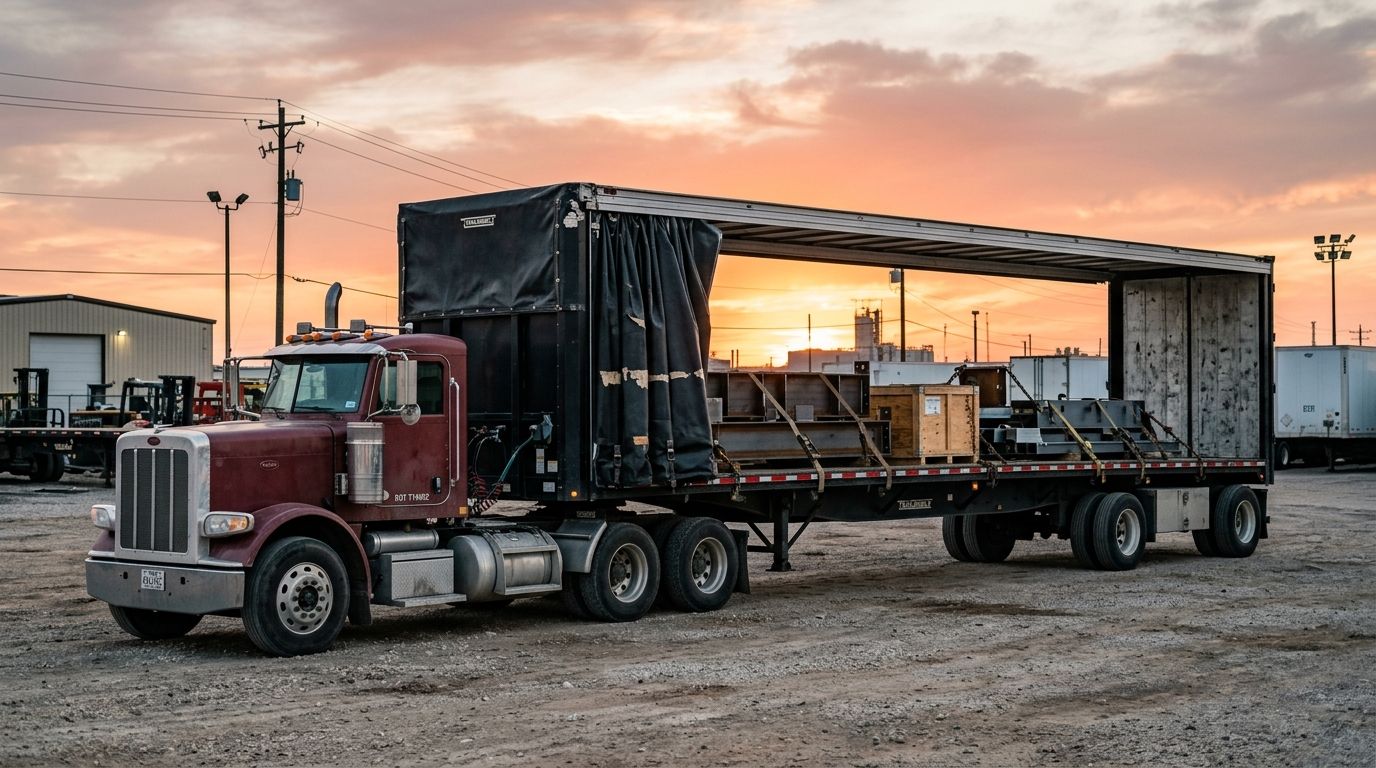
A Conestoga is a flatbed or step deck fitted with a rolling tarp system. It gives side, rear and top loading access when the tarp is retracted and full weather protection when it is closed. Typical flatbed Conestoga payload is 42,000–44,000 lbs because the tarp system adds roughly 2,000–2,500 lbs. Interior height under the bows is commonly 96–102 in on a flatbed configuration; longer or taller freight may need a step-deck Conestoga or a different trailer.
The premium exists when the shipper actually needs the cover or the faster dock time. When the load is just another flatbed, the Conestoga can still run it with the tarp open, but you lose the rate advantage and the tarp-fee line item ($50–100 on many open flatbeds).
| Spec | Conestoga | Standard flatbed |
|---|---|---|
| Max payload (typical) | 42,000–44,000 lbs | 46,000–48,000 lbs |
| Tarp system weight | ~2,000–2,500 lbs | None |
| Manual tarping time | Minutes (rolling) | 30–60 minutes |
| Typical rate premium | $0.15–$0.50 / mi | Baseline |
| Interior height under bows | 96–102 in | Open |
What does Candor’s Conestoga dispatch cost?
Fee is 7–11% of the carrier’s gross per load. No weekly fee, no setup fee, no termination fee. Multi-truck fleets can discuss the rate. No long-term contract. Cancel with written notice. You approve every load — there is no forced dispatch. Full details are outlined in our fee breakdown below.
What’s included: load search and rate negotiation, broker vetting and credit checks, carrier packets, rate cons, invoicing, factoring paperwork, detention / TONU / layover / tarp-pay pursuit, and weekly gross reports.
How does cargo securement work under the rolling tarp?
The tarp does not change the rules. Cargo must still be contained, immobilized or secured so it cannot shift and hurt the vehicle’s stability or maneuverability. The aggregate working load limit of the tiedowns must be at least half the weight of the article or group of articles.
As stated in 49 CFR § 393.100(b): “Cargo must be contained, immobilized or secured in accordance with this subpart to prevent shifting upon or within the vehicle to such an extent that the vehicle's stability or maneuverability is adversely affected.” And in 49 CFR § 393.106(d): “The aggregate working load limit of tiedowns used to secure an article or group of articles against movement must be at least one-half times the weight of the article or group of articles.”
We document loading method, blocking, bracing and special handling notes so the rate con and the dock instructions match what the driver actually faces.
What results has Candor delivered on open-deck freight?
What areas does Candor cover for Conestoga dispatch?
United States. Strongest open-deck and Conestoga density in Texas, Indiana, Ohio, Pennsylvania, Alabama and Oklahoma. Nearby metros and corridors without their own pages are covered from the same desk. We are not a local Texas office; we are Texas lane specialists who run those lanes every day.
Sources
- 49 CFR Part 393 Subpart I — Protection Against Shifting and Falling Cargo. eCFR / FMCSA (checked 2026-10-11).
- 49 CFR § 393.106 — General requirements for securing articles of cargo. eCFR / FMCSA (checked 2026-10-11).
- Conestoga Trailer Rates 2026. O Trucking (checked 2026-10-11).
- Conestoga Trailer Dimensions 2026. O Trucking (checked 2026-10-11).
Conestoga dispatch FAQ
Do Conestoga loads always pay more than flatbed?
No. They pay more when the shipper needs the cover or the faster dock time. Industry data as of 2026 puts the typical premium at $0.15–$0.50 per mile over a comparable open flatbed. If the load is just another flatbed, the premium disappears. Results vary by market, commodity and how the equipment requirement is written into the rate con.
Can I still collect detention, TONU, and layover on Conestoga freight?
Yes. We pursue detention, TONU (truck ordered not used), layover and any accessorial that belongs on the rate con. It only gets paid if the times and terms are documented.
Can a Conestoga run regular open flatbed freight when the tarp is retracted?
Yes. Retract the tarp and it loads and hauls like a standard flatbed. You give up the Conestoga premium on those loads, but a flatbed backhaul usually beats deadheading empty.
What commodities actually need a Conestoga?
Finished or coated steel, machinery, building materials, palletized freight and other weather-sensitive open-deck loads that still need side or top access.
Does Candor force dispatch or lock me into a contract?
No. Carrier approves every load. No long-term contract. Cancel with written notice. Fee is 7–11% of gross with no weekly, setup or termination fee.
How old does my MC authority need to be?
We target 6+ months. Newer authorities are accepted but not the primary audience.