Who is our flatbed dispatch service for?
Our flatbed dispatch service is for owner-operators and fleets of 1–10 trucks running open deck under their own MC, with authority at least 6 months old. Newer authorities can still apply, but we built the desk for carriers who know their truck and are short on board time and phone leverage.
You run flatbed, step deck, hotshot or a conestoga, a flatbed or step deck with a rolling tarp system, and you want Texas and steel-belt freight. We run those lanes every day.
Know your numbers before you take a rate. DAT's national flatbed spot rate averaged $2.59 a mile, linehaul only, for the week ending Sept 25, 2026. ATRI put the 2025 average cost to run a truck at $2.336 a mile, or $1.854 without fuel. Fuel surcharge pays for fuel, not profit, so we read the all-in rate before the linehaul.
What does a flatbed dispatcher do for you all day?
A flatbed dispatcher runs the boards, calls and vets brokers, negotiates the rate, sends your carrier packet, the setup documents a broker needs before booking you, and handles the rate con, paperwork and invoice. You drive and approve loads; we work the phone.
- Before you're empty: we look at where you unload and what reloads nearby, so the next pickup is lined up while you're still loaded. Deadhead is where weeks die.
- Running the boards: flatbed had the tightest board in the market at the end of September, a load-to-truck ratio of 41.38 per DAT, about 41 posted loads for every posted truck. A board that tight means we don't take the first lowball.
- Broker vetting: before we book you with a broker we haven't worked with, we check authority, credit and days to pay, how long that broker usually takes to pay. We also watch for double brokering, a broker re-selling a load it has no right to.
- Packet and rate con: your packet goes out with your COI, certificate of insurance. We read every rate con line by line before it reaches you, and nothing gets booked without your yes.
- Under load: we follow your U.S. business hours and stay on call 24/7 while the truck is under load.
- After delivery: BOL/POD, invoice and factoring paperwork, including the NOA, the notice of assignment that sends broker payment to your factor, plus a weekly gross report.
How do we get tarp pay, detention and TONU paid?
We get tarp pay, the extra pay for tarping, usually priced by drop size (4, 6 or 8 ft), plus detention, layover and TONU, the truck-ordered-not-used pay you're owed when a broker cancels after you're dispatched, agreed before booking and written on the rate con. If a pay item isn't on the rate con, it's a favor, not pay.
Tarp work. If the shipper wants it tarped, we price it before you roll, whether it's a steel tarp, the tarp sized for steel loads, or a smoke tarp, the small front tarp that keeps exhaust off the load. Tarping for free is a gym membership nobody asked for.
Detention. The DOT Inspector General found contracts typically allow about 2 hours to load or unload before detention starts, and carriers told the OIG that shippers sometimes refuse to pay when the BOL isn't signed with arrival and departure times. The same report estimated detention costs each truckload driver $1,281 to $1,534 a year, based on 2013 data. It also tied waiting to safety:
“We estimated that a 15-minute increase in average dwell time—the total time spent by a truck at a facility—increases the average expected crash rate by 6.2 percent.” (U.S. DOT Office of Inspector General, 2018)
So we get the free time and hourly rate on the rate con, and you get in and out times signed on the BOL.
TONU and layover. A cancelled load with no TONU amount on the rate con is an argument you usually lose. Same with layover when an appointment slides a day.
| Pay item | When it applies | On the rate con | Proof to invoice |
|---|---|---|---|
| Tarp pay | Shipper or receiver wants it tarped | Amount and drop size | Rate con line, tarped-load photos |
| Detention | Wait past free time | Free time and hourly rate | In and out times signed on the BOL |
| TONU | Load cancels after you're dispatched | Flat TONU amount | Dispatch time, arrival proof, cancel message |
| Layover | Appointment pushed a day or more | Daily layover amount | Old and new appointment in writing |
What flatbed freight and lanes do we run?
We book steel, coils, pipe, lumber, building materials and machinery, mostly in and out of Texas, then Indiana, Ohio and Pennsylvania, then Alabama and Oklahoma. Before a flatbed load reaches you, we check its securement needs against your chains and binders, straps, edge protectors and deck.
The baseline securement rule is in 49 CFR 393.106(d):
“The aggregate working load limit of tiedowns used to secure an article or group of articles against movement must be at least one-half times the weight of the article or group of articles.” (FMCSA, 49 CFR 393.106(d))
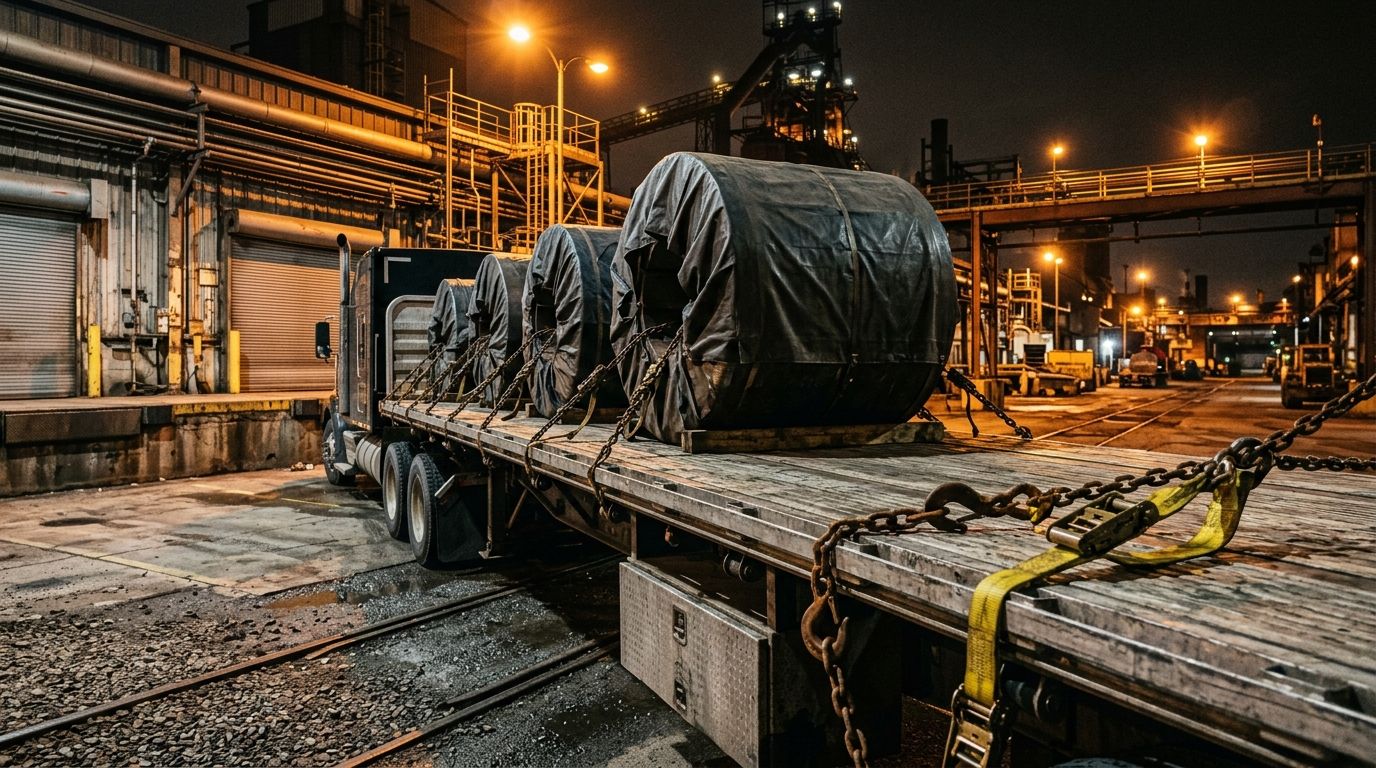
Coils, lumber, machinery and pipe add their own gear. On a coil load we confirm a coil rack, the cradle that holds a steel coil on the deck. On stacked lumber we confirm dunnage, the blocks between bundles. On pipe that can roll we confirm pipe stakes, uprights that keep pipe from rolling off the deck.
Inspectors check this at the scale. Cargo securement was the vehicle focus of CVSA's 2026 International Roadcheck, where inspectors wrote 1,724 cargo securement OOS violations, out-of-service orders that park the truck until it's fixed.
| Freight | Rule | Before you say yes |
|---|---|---|
| Steel coils, 5,000 lb or more | 393.120 | Coil tiedown pattern; coil rack or chocks |
| Machinery on wheels or tracks, 10,000 lb or more | 393.130 | At least 4 tiedowns |
| Bundled lumber and building products | 393.118 | Tier and tiedown rules; dunnage |
| Pipe, beams, general cargo over 10 ft | 393.106 and 393.110 | 2 tiedowns plus 1 per extra 10 ft; pipe stakes if it can roll |
| Anything with sharp edges | 393.104(f)(4) | Edge protectors where a strap can be cut |
Where flatbed money moved at the end of September: DAT's top flatbed origin regions for the week ending Sept 25, 2026, linehaul only.
| Origin region | Avg linehaul RPM | vs. a year ago |
|---|---|---|
| Ohio River | $3.22 | +39.6% |
| Southeast | $3.21 | +38.7% |
| Carolinas | $2.95 | +37.9% |
| Great Lakes | $2.85 | +35.0% |
Which open-deck equipment do we dispatch?
We dispatch flatbed, step deck, conestoga and hotshot, and book every open-deck load against the federal limits in 23 CFR Part 658: 102 inches wide on the National Network, and 80,000 lb gross with 20,000 lb on a single axle and 34,000 lb on a tandem on the Interstate.
Flatbed
Steel, pipe, lumber and building materials. Tell us your tarp set and securement gear, and we won't book a flatbed load your deck isn't kitted for.
Step deck
Taller freight and machinery. In Texas, legal height without a permit is 14 ft, per TxDMV. Machinery on wheels or tracks at 10,000 lb or more needs at least 4 tiedowns.
Conestoga
Conestoga freight has to stay covered, but the rolling tarp system saves you the tarp work. We book conestoga loads with shippers who ask for that coverage.
Hotshot
Partials and hot loads. Tell us your GCWR, the combined weight rating that decides your CDL needs, plus your deck length, and we only book what you can legally pull.
If a load runs OS/OW, oversize or overweight and needing permits, we flag it before you commit.
What does flatbed dispatch cost?
Candor charges 7–11% of the carrier's gross per load. There's no weekly fee, setup fee, termination fee or long-term contract, and you cancel with written notice. Fleets running several trucks can discuss the rate. See the full breakdown in our fee details below.
The fee covers load search and rate negotiation, broker vetting and credit checks, carrier packets, rate cons, invoicing, factoring paperwork, chasing detention, TONU, layover and tarp pay, and a weekly gross report.
Worked example, not a quote: a 1,000-mile load at DAT's $2.59 national flatbed average pays $2,590 linehaul. At 7% the dispatch fee is $181.30; at 11% it's $284.90. Your rate, miles and fee vary by load.
What results can you expect from our flatbed desk?
Expect pay items on paper and a desk that chases them. Candor has dispatched about 2,400–2,700 loads over 3+ years, mostly flatbed and step deck, and the carrier approved every one before it was booked.
Why the paper matters: in a 2014 OOIDA member survey cited by the DOT Inspector General, 37% of respondents, mostly small carriers, said they got no pay for detention. Results vary by lane, freight and season.
Carrier stories are published with carrier approval.
Where do we run open deck?
We dispatch open deck across the United States, with the heaviest volume in Texas, then Indiana, Ohio and Pennsylvania, then Alabama and Oklahoma. We run Texas lanes every day.
On Texas loads we book against state limits too: a 14 ft legal height without a permit, per TxDMV, and a $60 TxDMV single-trip permit when a non-divisible load runs over legal size or weight.
Sources
- Flatbed Report: Farm iron stacks up, and flatbed demand will feel it. DAT Freight & Analytics (checked 2026-10-11).
- Estimates Show Commercial Driver Detention Increases Crash Risks and Costs, but Current Data Limit Further Analysis (Report ST2018019). U.S. DOT Office of Inspector General (checked 2026-10-11).
- 49 CFR Part 393 Subpart I: Protection Against Shifting and Falling Cargo. eCFR / FMCSA (checked 2026-10-11).
- 23 CFR Part 658: Truck Size and Weight. eCFR / FHWA (checked 2026-10-11).
- Texas Size and Weight Limits. Texas Department of Motor Vehicles (checked 2026-10-11).
- General Single-Trip Permit. Texas Department of Motor Vehicles (checked 2026-10-11).
- Trucking's operational costs reached new high of $2.336 per mile in 2025 (ATRI). Truckers News (checked 2026-10-11).
- CVSA Roadcheck 2026: More than 10,300 vehicles placed out of service. TheTrucker.com (checked 2026-10-11).
- Broker Transparency Proposal Clears FMCSA and Heads to the White House. FreightWaves (checked 2026-10-11).
Flatbed dispatch FAQ
Are you a freight broker?
No. Candor is your dispatch agent and has no broker authority. We book freight under your MC, you set the lanes, and you approve every load. We never decide which carrier gets a load.
Do you force dispatch?
No. Nothing gets booked without your yes. Turn down a lowball and we keep running the boards.
Do I see the full rate con?
Yes. We read every rate con line by line, rate, tarp pay, detention, TONU and layover, and you see it before you approve the load. Brokers already have to keep a record of each transaction under 49 CFR 371.3; FMCSA's proposed update to that rule is still a proposal, not a final rule.
Do I have to sign a long-term contract?
No. There's no long-term contract, no setup fee and no termination fee. Cancel with written notice.
Can I talk to you in Spanish?
Yes, by text, email or WhatsApp. Phone calls are in English.